

Outgoings are the expenses that come with owning a property (eg, rates) and living in it (eg, electricity bills).
The landlord's outgoings
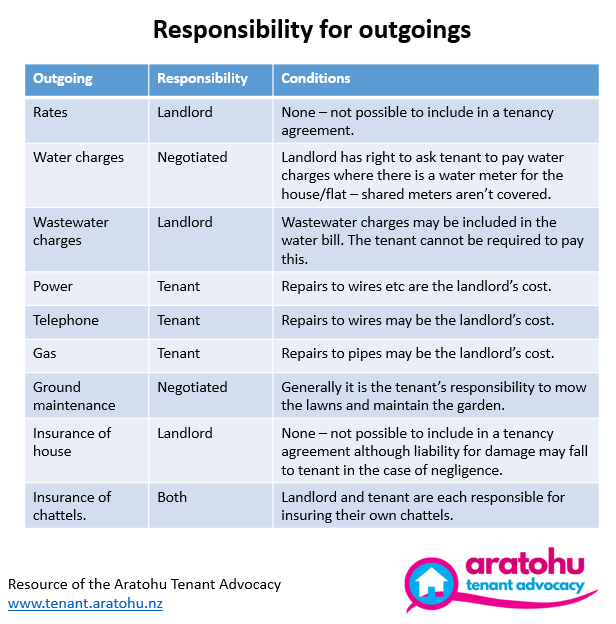
The landlord is responsible for paying for bills that must be paid whether or not a tenant is living there (s 39(1)(a) RTA). This includes rates, insurance (for the house and the landlord's chattels), and body corporate fees (s 39(2) RTA).
Landlords are also responsible for paying for expenses related to shared facilities, where the expense can't be attributed to a particular tenant (s 39(1)(b) RTA).
The tenant's outgoings
Tenants are responsible to pay for outgoings that can be directly attributed to their living at the property, and their use of the facilities (s 39(3) RTA).
In general, tenants will be responsible for paying for electricity, gas, telephone, and internet.
Any repairs required for broken electricity wires or gas pipes are likely to be the landlord's responsibility.
The tenant is usually responsible for maintaining the grounds, such as mowing the lawns. There may be costs associated with this, which are the tenant's responsibility.
Water and wastewater
Tenants should check their responsibility for water charges under the tenancy agreement. Tenants can be asked to pay for their water consumption if there is a water meter and this isn't shared by more than one flat (s 39(4) RTA).
Fixed water charges, and water consumption charges for more than one flat, must be paid by the landlord. General wastewater charges must also be paid by the landlord. Sometimes these charges will be listed on the same council bill.
If the tenant is going to be responsible for water consumption charges, they should ensure that they and the landlord take a water meter reading at the start of the tenancy, so that they don't pay for former tenants' water use.
If there are leaks in a house or flat that have increased the tenant's water consumption bill, the landlord can be asked to pay for part of the bill because of the landlord's responsibility for repairs and maintenance. The Tenancy Tribunal has taken this approach.
Installation of fibre broadband
If there is no fibre broadband already, tenants can ask their landlord to have it installed. Tenants can use this Tenancy Services request form to ask for broadband.
Landlords must:
- respond to the request within 21 days, and
- allow broadband to be installed if it can be done at no cost to them (unless the exceptions below apply), and
- take reasonable steps to make the installation happen within a reasonable period of time.
Landlords can refuse the request for a number of reasons, including because installation will:
- interrupt upcoming renovations or construction, or
- cause weather-tightness or structural issues to the building.
A full list of exceptions can be found in section 45(B)(2) RTA.
It is unlawful for a landlord not to respond to a request for broadband, or to refuse a request where no exceptions apply.
Unlawful tactics regarding outgoings
Landlords are not allowed to try and get tenants to pay for their own expenses, either as one-off requests for payment during the tenancy, or as a regular payment additional to rent.
There is information on what to do about unlawful charges and special conditions attached to rent.
Did you find this information helpful?